
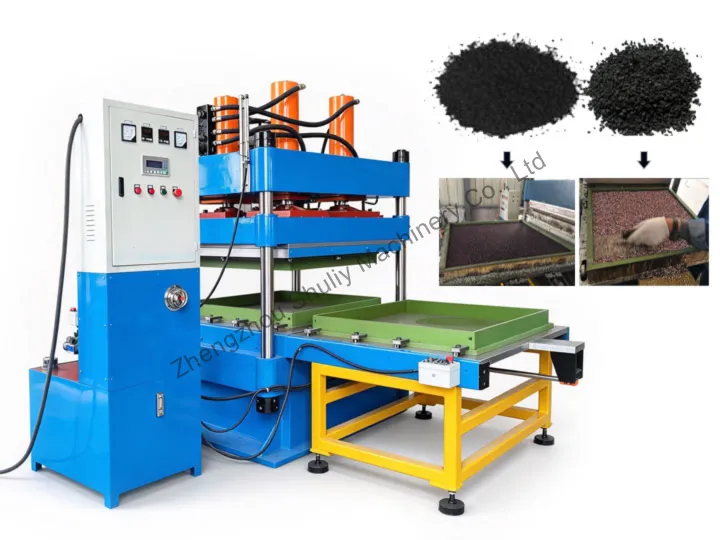
Shuliy rubber tile making machine is a hydraulic vulcanizing press that turns loose rubber granules into solid, elastic floor tiles. Mixed with polyurethane (PU) binder and color pigment, the granules are weighed into a steel mold, then heated and pressed while the binder cures — heating, molding and vulcanizing happen in one 3–8 minute cycle, producing dense two-layer rubber tiles from 10 to 45 mm thick.
For waste tire recyclers, this machine is where the money is actually made: rubber granules sell as a bulk commodity, while finished playground tiles and gym flooring sell as branded construction products at a far higher margin — the tile profit margin reaches about 36 % in our project analysis below. One press plus a set of interchangeable molds covers square tiles, large floor sheets and interlocking pavers: 10 standard shapes to choose from, plus custom patterns. A complete configured line — 250# mixer, 120-ton vulcanizing press and two mold sets — is available at EXW USD 157,000.
What does a rubber tile molding machine do?
- Consolidate loose raw material into a solid tile. The hydraulic system presses the granule-binder mix inside a closed mold while the heated platens cure it, so a pile of crumb rubber leaves the machine as a rigid, bonded floor tile.
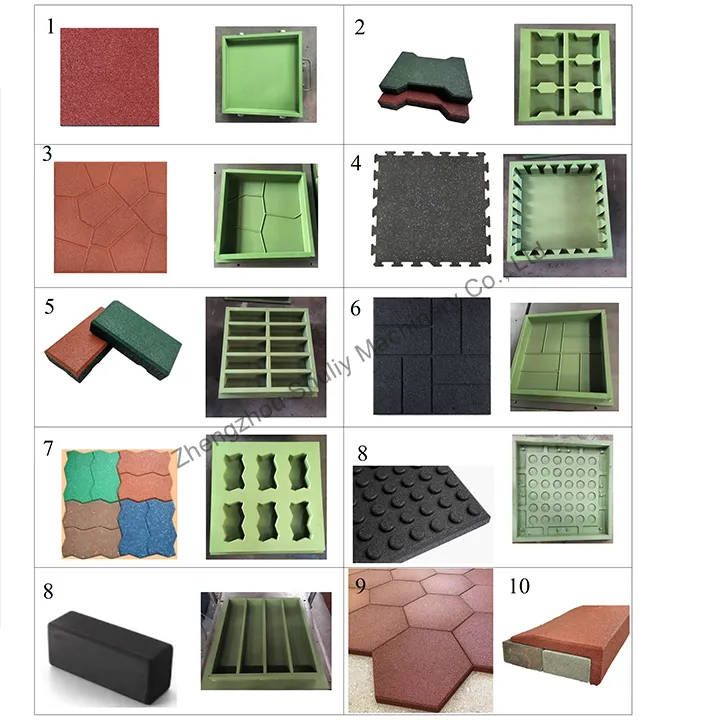
- Control size, thickness and shape through molds. One mold set with its adjustment tooling produces four thicknesses — 15, 20, 25 and 30 mm — and changing the mold changes the product: 300×300 mm and 500×500 mm tiles, 1000×1000 mm and 1200×1830 mm floor sheets, dog-bone and X-shaped pavers, or custom patterns.
- Convert waste rubber into a sellable product. Tiles made from tire-derived granules give recycling plants a high-value outlet for their own output, widening the product range beyond granules and powder.
- Engineer the performance of the floor. Granule size, binder ratio and curing profile determine elasticity, slip resistance, shock absorption and wear life — the rubber tile making machine is what makes that formula repeatable, batch after batch.
What tiles can you produce with one rubber paver making machine?
| Tile product | Typical thickness | Typical market |
|---|---|---|
| Playground safety tiles | 30–50 mm | Schools, kindergartens, public play areas (impact attenuation) |
| Gym & fitness flooring tiles | 15–25 mm | Weight rooms, cross-training zones, sports halls |
| Outdoor pavers / interlocking tiles | 20–30 mm | Garden paths, terraces, walkways (dog-bone and X molds) |
| Colored decorative tiles & floor sheets | 10–20 mm | Commercial spaces, leisure areas, kindergarten zones |
| Stable mats & utility mats | 25–45 mm | Equestrian stables, garages, industrial anti-fatigue flooring |
Basic tile formats are 300×300 mm, 500×500 mm, 1000×1000 mm and 1200×1830 mm, in thicknesses from 10 to 45 mm. All of the above run on the same rubber floor tile making machine — what changes is the mold set, the charge weight and the curing time. Plan molds around the two or three best-selling local products first, then expand.
Molds: the heart of the rubber tile making machine line
The mold — not the press — decides how wide your product range is and how much each tile costs you in labor and consumables. Our tile molds are made of high-carbon alloy steel: hard, wear-resistant and free of deformation after long production runs. We fabricate molds in any shape or pattern the customer specifies, with 10 standard tile shapes ready to choose from.
- Adjustable thickness tooling. Each mold is fitted with adjustment tooling that produces four product thicknesses — 15, 20, 25 and 30 mm — without buying a second mold. One mold set covers most of the commercial tile range.
- Teflon-coated mold surface. The coating makes the cavity non-stick, so tiles release cleanly and no release agent needs to be sprayed before every charge. That eliminates a daily consumable, removes a production step, and cuts both cost and cycle handling time.
- Push-pull rail mounting. Molds ride on slide rails, so changing products is fast and physical effort stays low — important when one shift runs several tile types.
- 1-top + 2-bottom mold configuration. Tile molds are supplied as one upper plate with two lower cavities (a 500×500 mm set weighs about 300 kg, a 1000×1000 mm set about 1,000 kg). While one lower mold cures inside the press, the second is filled outside — the operator never waits on the machine.
From waste tires to finished tiles: the production process
Rubber floor tiles are built from two layers of different-size granules: a colored wear surface of fine granules (0.6–1 mm) or fine rubber wire, colored with pigment, over a black cushion base of coarse granules (1–4 mm) or rubber wire (10–15 mm) made from waste tires. The full cycle of rubber tile making machine runs: raw material + binder + pigment, metered in proportion → mixing → pressing (vulcanizing) → inspection.
- Raw material preparation. Waste tires are cut, shredded and separated from steel and fiber, then ground into granules — 0.6–1 mm fine granules for the colored wear layer and 1–4 mm coarse granules for the black base layer. A broyeur de pneus and a séparateur de fil en acier des pneus en caoutchouc upstream let you produce your own granules.
- Mixing (3–5 minutes). Granules, PU binder and pigment are mixed in the paddle mixer until every granule carries a thin, even film. Only mix what you use immediately — the binder starts to set, so batches are timed to pressing. The mixer uses several barrels, so it mixes different colors in parallel without cross-contamination or color variation.
- Weighing. The mixed fine and coarse granules are weighed to the tile design so every tile carries the same density and weight.
- Charging the mold. The metered material is spread into the mold and leveled with a knife — colored granules first, then the black base layer.
- Vulcanizing (3–8 minutes). A non-stick cloth is laid over the filled mold, which then closes between the heated platens. Heating, molding and curing happen simultaneously; the rubber tile vulcanizing press opens automatically on the timer alarm, the tile is demolded and racked to cool.
- Inspection. Finished tiles are checked for consistent appearance, no color difference, on-size dimensions and a defect-free surface before packing.
Rubber tile making machine design: mixer and vulcanizing press
The rubber tiles forming machine line has two core units, each designed for round-the-clock tile production:
- Mixer. Mixing barrel, motor, agitator and support frame. Multi-barrel configurations mix several colors at the same time, which raises output and prevents color difference between batches.
- Rubber tile vulcanizing press. A column-type, down-acting hydraulic structure: the heating platen lifts under the weight of the platen, table and piston, and closes as the piston rises, with hydraulic oil supplying the pressing force. The machine base and cylinder are cast in ductile iron for strength and wear resistance, sealed with oil-resistant rubber rings inside the cylinder. Electric heating tubes keep the workshop clean and the system reliable; a two-position control valve opens or closes the platen.
- Control system. Intelligent control with a human-machine interface: temperature and time are held accurately, with a timed alarm ending each cycle. Automatic temperature control, low noise and low vibration mean new operators run the machine confidently after short training — no specialist staff required.
The whole machine integrates the main unit, electrical control and hydraulic system in one frame: simple installation, safe operation and easy maintenance.
Rubber paver making machine models and specifications
The rubber tile production line combines one mixer with one vulcanizing press, sized to your tile formats:
| Unit | Modèle | Spécification |
|---|---|---|
| Rubber powder mixer | 250# | Mixing speed: 18 r/min Mixing time: 3–5 min Power: 4 kW 1 set per line |
| Vulcanizing press (small) | XLB-D550×550 | Total pressure: 50 t Heating plate: 550×550×45 mm Layer: 4 layers Motor power: 3 kW |
| Vulcanizing press (single layer) | XLB-D1100×1100 | Total pressure: 120 t Heating plate: 1100×1100×50 mm Layer: 1 layer Motor power: 4 kW |
| Vulcanizing press (double layer) | XLB-D1100×1100 | Total pressure: 120 t Heating plate: 1100×1100×50 mm Layer: 2 layers Motor power: 4 kW |
The 120-ton press is our standard configuration for 500×500 mm and 1000×1000 mm tiles, supplied with two 1-top-2-bottom mold sets. It produces 12–16 pieces of 1000×1000 mm tile per hour — roughly 100–130 m² per shift, matching the 3,000 m²/month factory model below. Mold set weight: about 300 kg for the 500×500 mm set and about 1,000 kg for the 1000×1000 mm set.
Key parameters at a glance of rubber brick making machine
| Parameter | Spécification |
|---|---|
| Tile formats | 300×300 / 500×500 / 1000×1000 / 1200×1830 mm (mold-dependent) |
| Tile thickness | 10–45 mm; one mold with adjustment tooling makes 15 / 20 / 25 / 30 mm |
| Mold shapes | 10 standard shapes; custom shapes and patterns on request |
| Mold material & surface | High-carbon alloy steel, Teflon-coated non-stick |
| Mixing time | 3–5 min per batch |
| Vulcanizing cycle | 3–8 min (heating, molding and curing simultaneous) |
| Press structure | Column-type down-acting hydraulic, ductile iron body |
| Heating | Electric heating tubes, automatic temperature control with timed alarm |
| Power supply | Customized to local grid (3-phase 380 V / 415 V / 440 V, 50/60 Hz) |
| Operators per line | 4–5 workers |
| Factory area | From 30 m² for a small-medium line, with water and power |
Project analysis: Is a rubber tile factory profitable?
Numbers below are our standard project model for one rubber tile making machine line producing 3,000 m²/month of 500×500×20 mm colored rubber tiles — the same calculation sheet we give customers during quotation:
| Article | Figure | Note |
|---|---|---|
| Raw material mix | 85–90% rubber granules + 10–15% additives (binder, pigment) | Low-cost feedstock, especially with in-house granules |
| Power consumption | About 3 kWh per m² of tile | Electric-heated platens |
| Maintenance | About USD 40 per month | No fast-wear parts; simple upkeep |
| Working capital | From USD 2,000 per production cycle | Increase with scale |
| Labor | 4–5 workers per line | Simple process, short training |
| Profit margin | Up to about 36% | Full-load operation |
| Payback period | 3–4 months at full production | Based on the margin and cost figures above |
| Environnement | No waste gas / wastewater / residue discharge | No secondary pollution |
Installation and commissioning take 3–5 days depending on the site. Because the process is short and forgiving, the tile line suits both new investors and tire recyclers adding a downstream product — the rubber paver making machinery investment is modest, while the finished product sells into construction and sports-surface markets.
How to choose the right rubber tile making machine?
- Start from the product, not the rubber tile vulcanizing press. Pick the two or three tiles your local market buys (playground vs gym vs pavers); thickness and mold size then dictate platen area and tonnage.
- Decide where your rubber granules come from. Tire recyclers with an existing ligne de recyclage de pneus usagés feed the press directly; flooring-only buyers purchase granules and should budget mixer capacity and binder stock instead.
- Count molds as part of the rubber floor tile making machine. A vulcanizing press with one mold makes one product. With adjustment tooling, one mold already covers four thicknesses — add molds only for new shapes.
- Match the power supply. Customization for 3-phase 380 V / 415 V / 440 V and 50/60 Hz is standard for our export machines.
- Remember it is one unit in a line. A complete tile shop needs granulate supply, the mixer, the vulcanizing press, mold sets and a cooling rack area — we quote the line, not just the press.
What affects the rubber tile making machine price?
Quoted prices in USD move mainly with five variables: platen size and tonnage, number of layers, the mold set (shape count and adjustment tooling), mixer configuration (single vs multi-barrel), and the level of automation (manual leveling through automatic weighing and feeding).
Because the configuration is built around your tile products and output target, we quote each rubber tile making machine individually. Tell us your tile sizes, daily output and granule source, and we will send a configuration plan with a detailed quotation.
Reference package price: a complete configured line — 250# rubber powder mixer, 120-ton XLB-D1100×1100 vulcanizing press and two 1-top-2-bottom mold sets (500×500 mm and 1000×1000 mm) — is quoted at EXW USD 157,000. Smaller XLB-D550×550 setups and different mold combinations are priced accordingly.
Service and support for rubber floor tile making machine
- Multiple machine specifications, customized to customer requirements.
- Production technology support: installation, commissioning, operator training and factory-setup guidance.
- One-year warranty — equipment problems within the period are repaired or replaced.
- Long-term supply of spare parts, plus mold design and manufacturing.
- Binder, pigment and other raw materials supplied on request, so you can start producing immediately.
FAQ of rubber tile making machine
What raw materials does a rubber tile machine need?
Rubber granules (0.6-1 mm fine for the colored wear layer, 1-4 mm coarse for the black base layer), polyurethane binder and color pigment. The standard mix is 85-90% granules and 10-15% additives by weight.
Can I use granules from my own tire recycling line?
Yes. Granules from a rubber grinding mill and steel wire separator are the standard feed. Producing your own granules is what turns the tile line into a full waste-tire-to-product business.
What tile sizes, shapes and thicknesses can one machine make?
Basic formats are 300×300, 500×500, 1000×1000 and 1200×1830 mm, with 10 standard shapes plus custom molds. One mold with adjustment tooling produces four thicknesses: 15, 20, 25 and 30 mm; the full machine range covers 10-45 mm.
How long is the production cycle?
Mixing takes 3-5 minutes per batch, and vulcanizing takes 3-8 minutes per tile batch, with heating, molding and curing happening simultaneously. Mix only what will be pressed immediately, because the PU binder starts to set.
Do I need release agent for every tile?
No. The molds have a Teflon-coated non-stick surface, so no spraying is needed before each charge. That saves consumable cost and one production step per cycle.
How many workers and how much space does a line need?
A small-medium rubber tile manufactuing line runs with 4-5 operators in a factory of 30 m² or more with water and power supply. Installation and commissioning take about 3-5 days.
What power supply does the press require?
We customize for 3-phase 380 V, 415 V or 440 V at 50/60 Hz to match the grid in your country. Power consumption is about 3 kWh per square meter of finished tile.
What warranty and after-sales service do you provide?
One-year warranty with repair or replacement, long-term spare parts, mold design and manufacturing, plus installation, training and factory-setup guidance. Binder and pigment can also be supplied.
How much does a complete rubber tile making machine set cost?
A full configured set – the 250# mixer, a 120-ton XLB-D1100x1100 vulcanizing press and two 1-top-2-bottom mold sets (500×500 mm and 1000×1000 mm) – is quoted at EXW USD 157,000. Final price depends on press model, number of layers and mold quantity.
Ready to add value to your recycled rubber? Contact Shuliy for a rubber tile making machine quotation, mold options and a complete tile production plan sized to your output target and budget.