
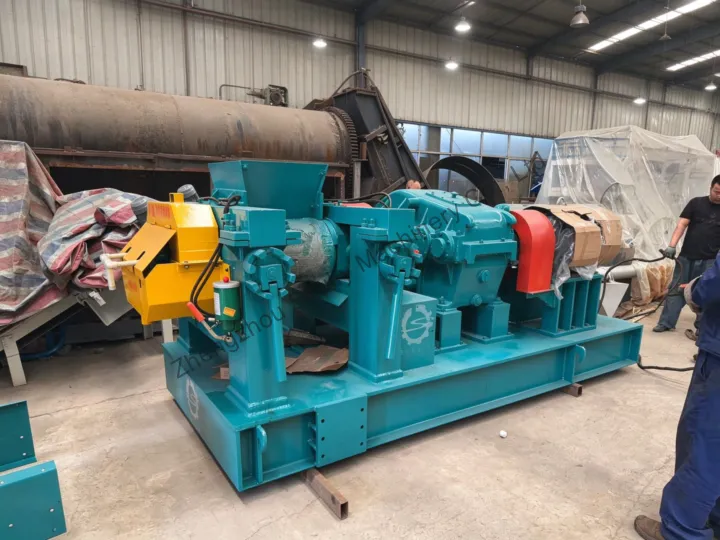
A Colombian customer ordered a compact Shuliy rubber powder line centered on an SL-350 grinder, with a vibrating screen, back-flow conveyor, and tire crusher. The system reduces 5–10 cm tire blocks to 5 mm crumb at 300 kg/h and 0.5 mm, about 40-mesh powder at 70 kg/h.
All motors are configured for Colombia’s 220 V, 60 Hz, three-phase supply. The crusher provides steady 10–12 mm feed, while screening and return conveying maintain stable fineness for rubber tiles, mats, modified asphalt, or further tile production.
A customer in Colombia purchased a complete small rubber poeier masjien line from Shuliy: an SL-350 rubber grinder with its vibrating screen and back-flow conveyor, plus a tire crusher as the front stage. The line grinds 5–10 cm tire blocks into crumb rubber at 300 kg/h and finishes 0.5 mm (≈40 mesh) rubber powder at 70 kg/h — with every motor wound for Colombia’s 220 V / 60 Hz / 3-phase grid.
What the Colombia customer needed
The requirement was a compact, self-contained powder line rather than a full plant: take cut tire blocks, produce 40-mesh rubber powder for further products, and run on the local 220 V / 60 Hz supply without a transformer workaround. Two constraints shaped the configuration:
- Particle range. The grinder must handle 5–10 cm tire blocks down to 5 mm crumb, then fine-grind to 0.5 mm — two different capacity figures (300 kg/h vs 70 kg/h) that must be balanced across the line.
- Front-stage sizing. A band versnipperaar-style crusher outputting 10–12 mm pieces feeds the grinder steadily without overloading it.
Equipment supplied: the full configuration
| Unit | Model / key spec | Krag | Capacity & size |
|---|---|---|---|
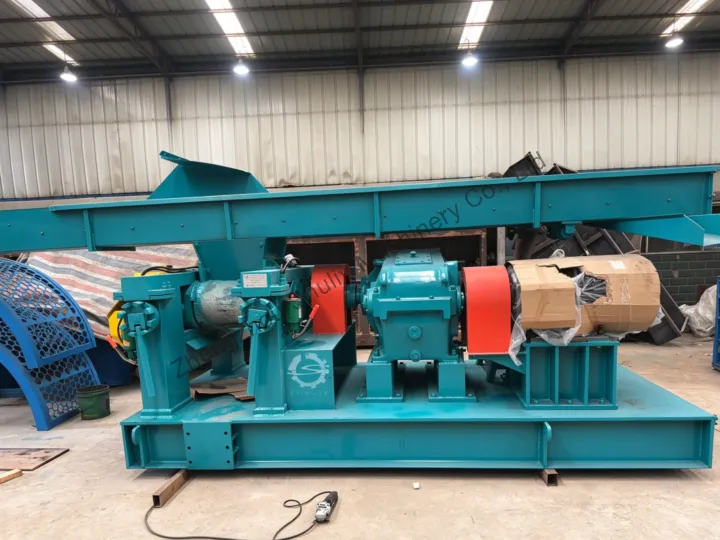
| Rubber grinder | SL-350, main and auxiliary rollers φ350×500 mm | 30 kW, 220 V, 60 Hz, 3-ph | 300 kg/h at 5 mm; 70 kg/h at 0.5 mm (≈40 mesh); 3.7×1.75×1.6 m; 6.3 t |
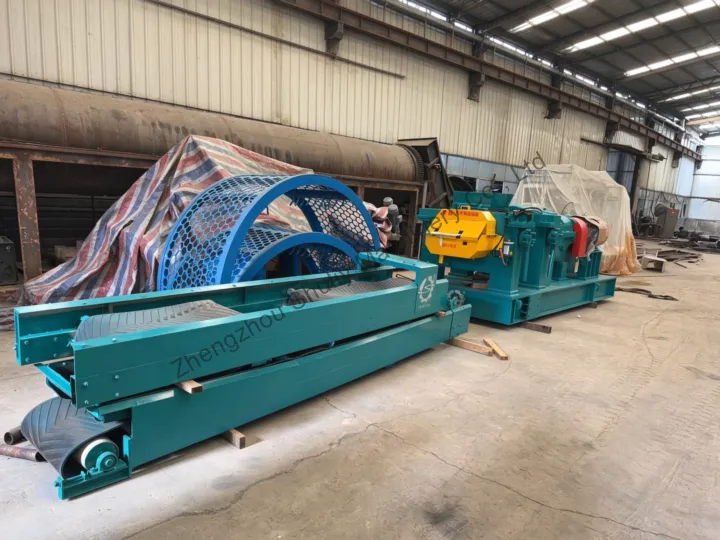
| Main vibrating screen | Screens ground powder toward the magnetic separator or back to the grinder | 4 kW, 220 V, 60 Hz, 3-ph | 7.5×0.5×0.35 m; 600 kg; 1 set |
| Back-flow conveyor | Returns oversized pieces to the grinder for a second pass | 1.5 kW, 220 V, 60 Hz, 3-ph | 7.2×0.7×0.6 m; 700 kg; 1 set |
| Tire crusher | 18 rotary + 2 fixed blades, SKD11 tool steel; 10–12 mm screen | 15 kW, 220 V, 60 Hz, 3-ph | 300 kg/h output; 1.55×1.17×1.7 m; 750 kg |
Why this configuration works
- Balanced capacity chain. The crusher delivers 300 kg/h of 10–12 mm pieces — exactly the throughput the SL-350 consumes at its crumb stage, so neither machine starves or floods the other.
- Closed-loop fineness control. The vibrating screen separates on-size powder, and the back-flow conveyor sends oversize material to the grinder for a second pass. That is how a single grinder reaches a stable 40-mesh product at 70 kg/h.
- Grid-matched motors. All four units are built at 220 V / 60 Hz / 3-phase — the standard industrial supply in Colombia — so installation needs no voltage conversion hardware.
- SKD11 blades. The crusher’s rotary and fixed blades in SKD11 tool steel resist the abrasion of tire rubber with steel cord still present, keeping the 10–12 mm output size consistent between regrinds.
Package and deliver rubber powder grinder machine to Colombia
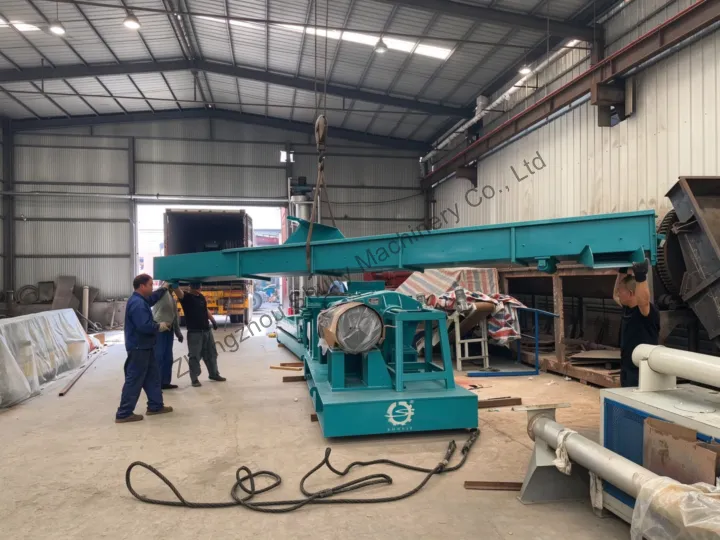
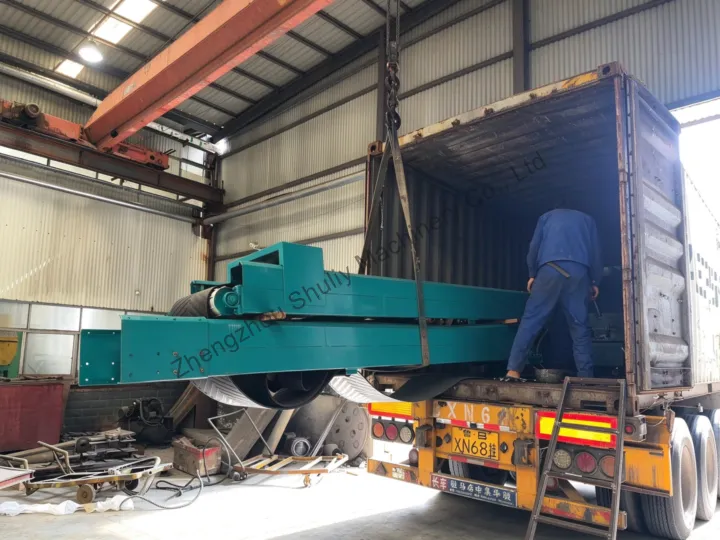
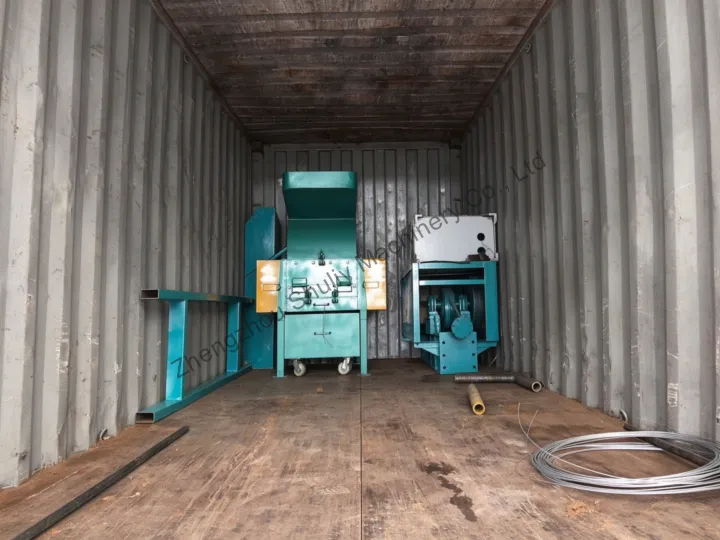
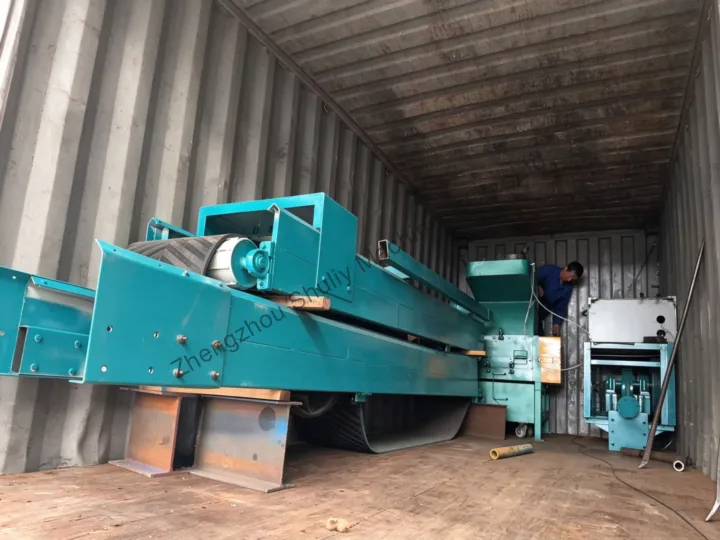
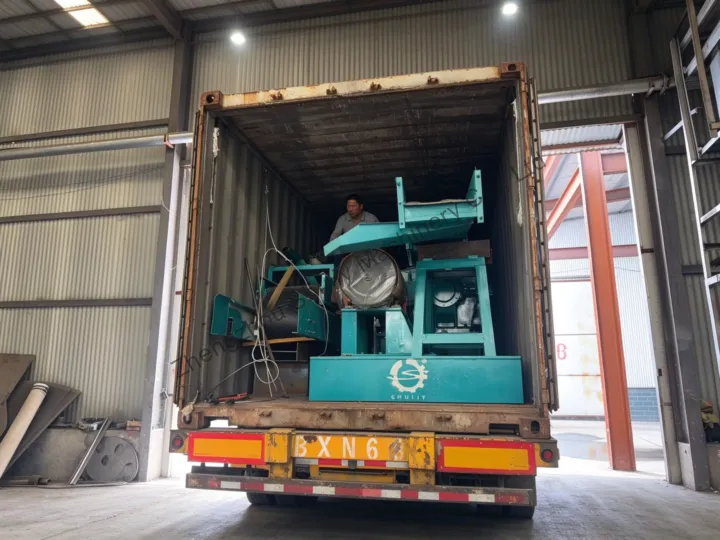
All four units in this Colombia order were shipped as naked cargo — the machines go directly into the shipping containers without wooden crate packing. The grinder, crusher, screen and conveyor are lashed and chocked to the container floor with steel straps and timber wedges; working surfaces are coated and wrapped in moisture-proof film, and the motors and electrical cabinets get an extra waterproof layer; spare parts and the SKD11 blade set travel in steel boxes fixed beside the machines.
Container-direct loading cuts freight cost and lead time: no crate fabrication, no fumigation or IPPC heat-treatment formalities for solid wood packing, and more equipment fits per container. At the destination port, a crane or forklift lifts the units straight off and sets them onto the prepared concrete foundation.
Where the powder goes next
40-mesh powder from this line suits rubber tiles, mats and modified asphalt. For Colombian buyers who want to keep the value in-house, the same granulate can feed a rubber tile making machine downstream — turning the powder into playground and gym flooring instead of selling it as a bulk commodity.
FAQ of this Colombia rubber powder line
What capacity is the SL-350 rubber powder machine?
The SL-350 grinds 5-10 cm tire blocks to 5 mm crumb rubber at 300 kg/h, and to 0.5 mm (about 40 mesh) rubber powder at 70 kg/h. Its main and auxiliary rollers are both 350 x 500 mm, driven by a 30 kW motor.
Does the machine work on Colombia’s power supply?
Yes. Every unit in this order – SL-350 grinder, vibrating screen, back-flow conveyor and tire crusher – is built for 220 V, 60 Hz, three-phase, which matches Colombia’s industrial grid. We customize voltage and frequency for other countries.
Why is a tire crusher needed before the grinder?
The grinder accepts 5-10 cm blocks. A crusher with a 10-12 mm screen cuts whole tires to a consistent feed size at 300 kg/h, protecting the grinder rollers and stabilizing the powder output.
How is 40 mesh fineness kept stable?
The main vibrating screen routes on-size powder forward and oversize material onto the back-flow conveyor, which returns it to the grinder for a second pass. This closed loop holds the 0.5 mm target without a second grinder.
Planning a rubber powder line in Colombia or elsewhere in Latin America? Send us your tire feed size, target mesh and local voltage, and Shuliy will quote a matched grinder-crusher configuration.